

A walk-behind string trimmer, also named walk-behind weed trimmer, provides a great alternative to a lawnmower for maintaining the patch of green outside your house. This is especially true where the terrain is irregular, and includes multiple obstacles like rocks.
In our Best Walk-Behind String Trimmer guide, we’ve evaluated a range of machines that elevate yard work beyond what a standard mower handles. From rugged gas-powered walk-behind string trimmers to a standout electric model that brings quieter, lower-maintenance operation to the table. Modern electric walk-behind weed trimmers are easier to start, lighter to maneuver, and produce zero emissions during use, making them ideal for homeowners who value convenience and environmental friendliness without sacrificing capability. For a broader perspective on how electric and gas tools compare across lawn equipment, Consumer Reports highlights that battery-powered tools are quieter and easier to maintain than gas alternatives, though each has its place depending on yard size and needs.
Whether you’re tackling overgrown edges that a conventional lawn mower can’t reach — or looking for a complement to your main mower — this list has you covered. For those with larger properties, you may also find our recommendations on the best lawn mowers for large yards helpful. And once you’ve chosen a trimmer, pairing it with the right cutting cord is crucial. So, check out our in-depth guide to the best trimmer line options to ensure clean, efficient cuts every time.
In this guide, we break down the real strengths and trade-offs of each pick. You’ll see which machines excel at thick weeds, which are easier to control on uneven ground, and which offer the best balance between power, noise, and maintenance. Spoiler alert, the Earthquake 40314 Walk Behind String Mower is our favorite out of the 21 products we reviewed in total. Read along to check out all models and choose confidently based on how your yard actually behaves, not just the specs on paper!
If you were to start looking through the various vendor and manufacturer websites, you would probably need to set aside a lot of your time for the exercise. We know this since we’ve already been through similar motions. Nevertheless, now that we’ve done the relevant research, you will find that all you need to do is read the write up below. Some of the factors that we considered are the cutting swath, engine, and trimmer line diameter of the devices. These are the most important features when it comes to the performance of the devices. Other criteria include warranties, weight, and additional benefits. While these may not affect performance, they might be of interest to the user in different ways. You can thus see the fruits of our labor in the table below that ranks the best walk-behind string trimmers according to merit. You may also appreciate the additional information provided in the in-depth reviews section as well as the buying guide.
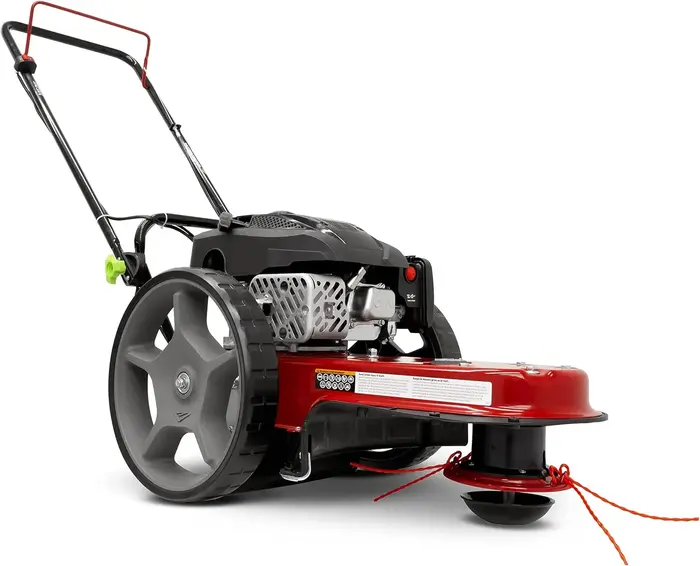
Other features: 14-inch wheels, one-piece steel deck, tough nylon line
The Earthquake 40314 Walk Behind String Mower, equipped with a powerful 79cc Viper Engine, delivers high-performance edging for lawns, sidewalks, and driveways, and is versatile enough for minor trenching tasks. This tool simplifies landscaping with its ability to adjust the cutting angle between 70 and 110 degrees, accommodating different types of grass and providing precise, professional edges.
Adding to its convenience, this walk-behind string mower offers simple depth control. Users can easily adjust the cutting depth from 0.5 to 3.5 inches using a straightforward lever, making it adaptable to various landscaping needs. Safety and utility are enhanced with a debris guard that protects against flying debris and a built-in tool holder that keeps essential tools within reach for quick detailing.
Backed by a 5-year limited warranty, the Earthquake 40314 ensures reliability and long-term support. This edger is a practical and efficient choice for anyone looking to maintain crisp, clean edges around their property, blending power and convenience in a robust package.
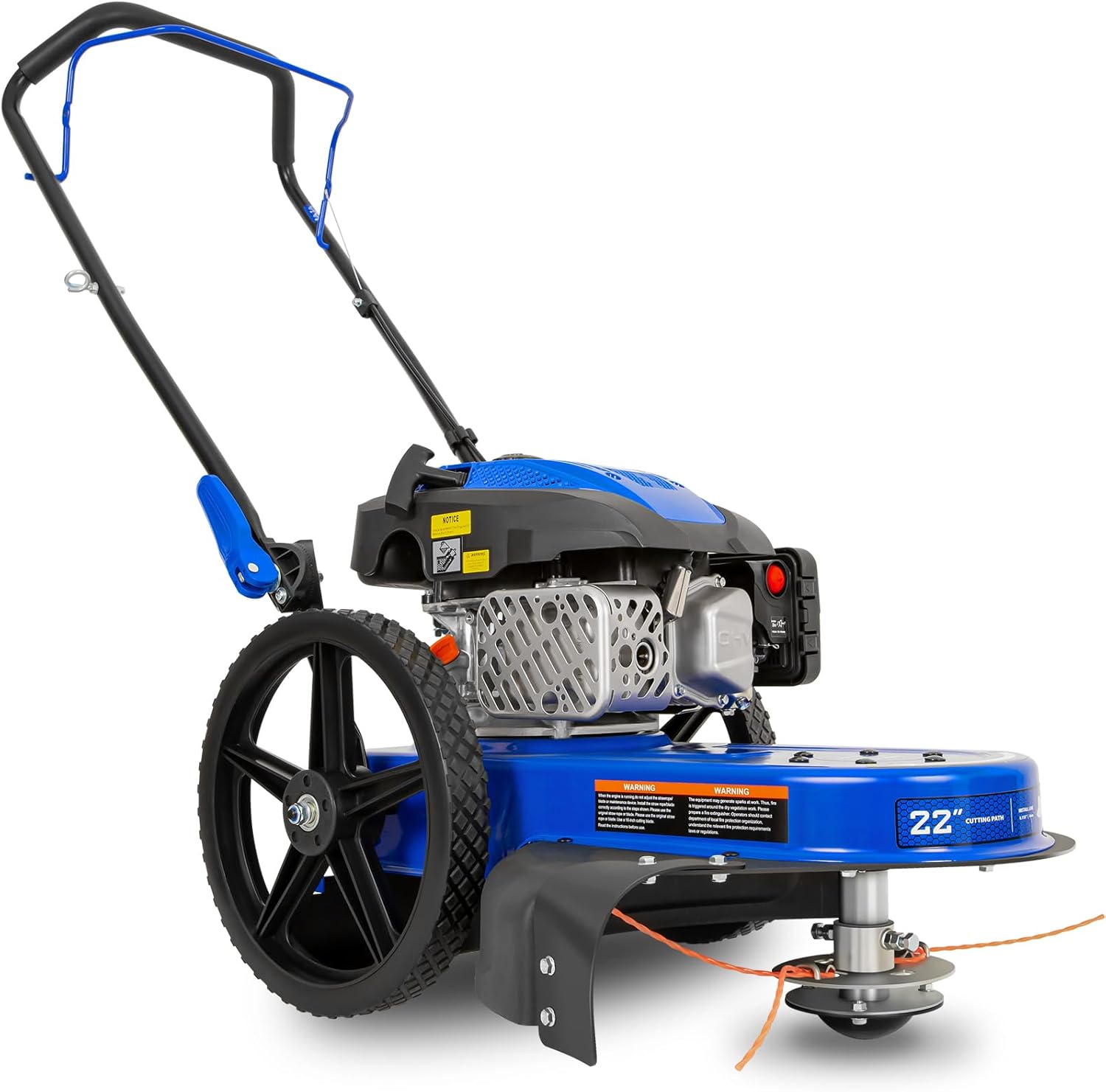
Other features: big rear wheels, foldable ergonomic handle
The BILT HARD 22-Inch Walk Behind String Trimmer is a workhorse worth every penny. The mower is incredibly powerful and sturdily built. It packs a punch with plenty of features that distinguish it from most machines within its price range.
The mower sports a manual recoil start ignition system, a heavy-duty gas engine, a sizeable 0.85-qt. fuel tank, and 16.9-fl.oz. oil capacity.
Despite its hefty build, the BILT HARD mower is pretty easy to control thanks to the two-position handlebars and 14-inch never-go-flat tires. Also, it was built with your safety in mind. The spin-stop blade stop feature will stop the blade without interfering with the engine whenever you need to step away for a moment.

Other features: adjustable handle bar, Never-Go-Flat 14-inch wheels, steel and plastic construction, 1.5”- 4.0” toolless adjustable cutting height
The Earthquake 60V Electric Walk-Behind String Trimmer stands out as a compelling middle ground, offering the convenience of cordless power with the clout to tackle more challenging grass and weeds. No fuel to carry, no smelly exhaust, and far less noise for a more pleasant trimming experience. Easy assembly using the instruction video below.
Right out of the box, this mower impressed me with its dual 60V, 4Ah batteries, delivering up to roughly 90 minutes of runtime when both are in play. On the uneven part of my half-acre yard, I was able to mow most areas without swapping packs mid-session. The brushless direct-drive motor feels responsive under load, especially when mowing through thicker patches that typically bog down smaller electrics.
One feature I appreciated is the three-speed dial, which lets you dial back power for precision trimming near edges or dial up for open turf. The offset cutting head helped me get close to fences and deck posts without repeatedly reaching around awkward angles — a refinement that many simple push units lack. The lightweight but solid build, paired with large 14″ airless wheels, made maneuvering over uneven ground surprisingly smooth.
I wasn’t alone in enjoying this machine either. Enthusiasts on mower forums have similar takeaways; one Reddit user said a walk-behind string mower “clears brush I never thought I could cut with a normal weed eater”, and praised its ease of use (see Reddit discussion).
Of course, there are trade-offs. It won’t replace a heavy-duty gas mower for extremely tall, wet grass. Battery performance naturally tapers as the charge drops. However, for most residential lawns and mixed vegetation, this Earthquake model strikes an excellent balance of power, convenience, and low maintenance.

Other features: fold-down handle, 14-inch wheels, steel deck, 5 positions of cutting height, comes with 20-inch trimmer line
The SENIX walk-behind weed trimmer is designed for homeowners who find a standard push mower limiting once grass gets tall, the ground is uneven, or mixed with weeds. I’ve used it on areas where grass was knee-high and patchy, and it powered through without clogging or constant stopping.
Built around a 160 cc 4-cycle gas engine, this unit delivers strong torque without too much vibration, exhaust and fuel consumption. I found it responded well even when the vegetation got dense; the wide 22-inch cutting swath with heavy 0.155-inch trimmer line meant fewer passes and efficient coverage of larger areas.
The high-wheel design and 14″ rubber wheels give surprisingly smooth maneuverability, whether crossing uneven ground or edging around flowerbeds. I also appreciate the five-position height adjustment that lets you tailor cut height from about 1.6″ up to just over 3″, perfect for either rough cleanup or a more controlled finish.
Aesthetically and functionally, the steel deck feels solid and durable under use. I liked that the ergonomic handle and fold-down design make extended yard sessions less tiring and storage less of a chore than bulky push mowers.
Of course, it’s louder and heavier than electric options, and the finish isn’t turf-perfect like a dedicated lawn mower. But, for overgrown yards, rough lots, and thick weeds, this SENIX walk behind weed trimmer handles itself well.
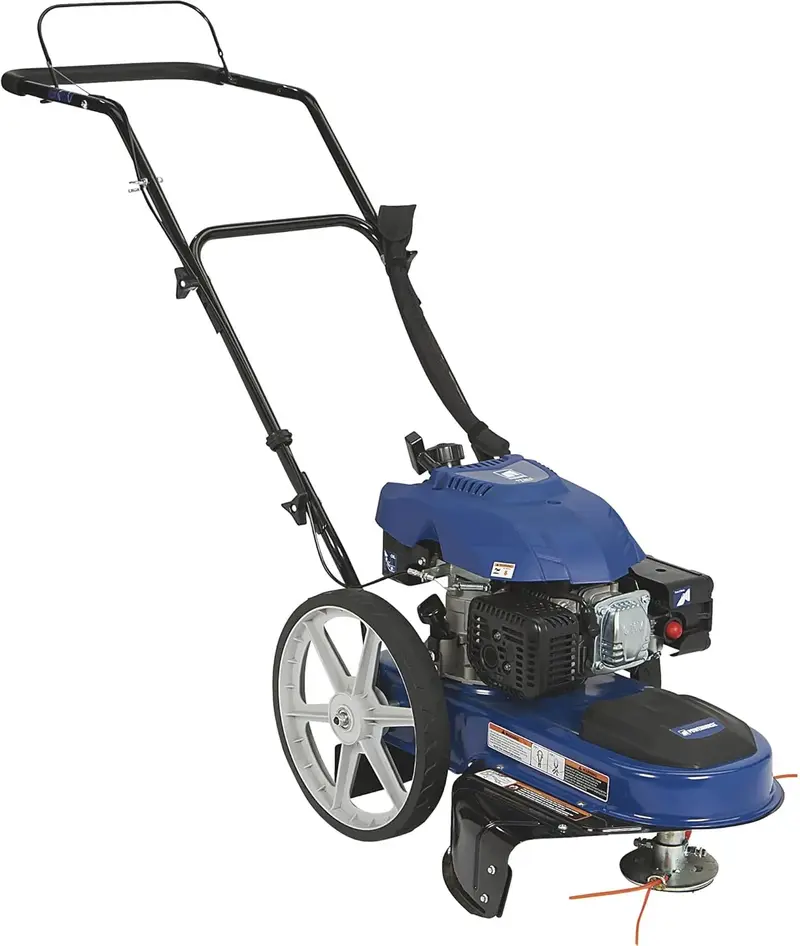
Other features: with recoil start, delivers 3000 RPM
The Powerhorse Walk-Behind String Trimmer Mower is a purpose-built machine meant to tame tall grass, thick weeds, and rough areas where blades and low decks become liabilities. What really sets this model apart is its Highest-CC Engine in the category, which explains both its cutting authority and its weight. This is not a lightweight, finesse machine. It’s heavy because it’s built around a large-displacement engine designed to keep pulling when other walk-behind trimmers bog down. In use, that does mean pushing a bit harder, but it also means a more sturdy machine.
Despite that oversized engine and solid steel construction, the price remains surprisingly low compared to competing high-wheel trimmers. You’re essentially trading portability for raw power and durability, making this a strong value pick for users who prioritize performance over ease of lifting or transport. If you want the most engine for the money and don’t mind a heavier machine, this model clearly earns its “Highest CC Engine” label.

More features: 5 cutting heights: 1.5 in. to 3.5 in., onboard trimmer string storage, rugged 14 in. ball bearing wheels
Most individuals don’t just wake up one morning and decide to get a string trimmer. They often need to determine whether the tool is worth getting or not. Of course, the decision to make the purchase is followed by research on budget requirements as well as which models provide the best value. If you did this independently, it would take up a lot of your time and resources. However, since our team has already done this, we wish to save you the hassle. This is why we have provided the purchase options above as well as their benefits. Also, the process of deciding which of the devices to pick from the list above will be easier if you read the buying guide below.

A walk behind string trimmer is a gardening tool that works more or less like a lawnmower. It is able to cut through shrubs and brush easily. One significant difference between the two gadgets is the cutting elements. While the lawnmower uses a blade, the string trimmer uses a string of a particular diameter to cut through grass and small plants.
Most of these devices are not self-propelling; hence they need you to walk behind and push them forward.
If you decide to pick these tools over regular lawn mowers, then you will likely know about the benefits. For one, these gadgets are safer than their counterparts.
Lawnmowers use blades to cut grass, which are just as capable of cutting through skin and bones as well. Should an accident happen, the lawnmower will definitely cause more damage to your body. You needn’t worry about that with a string trimmer.
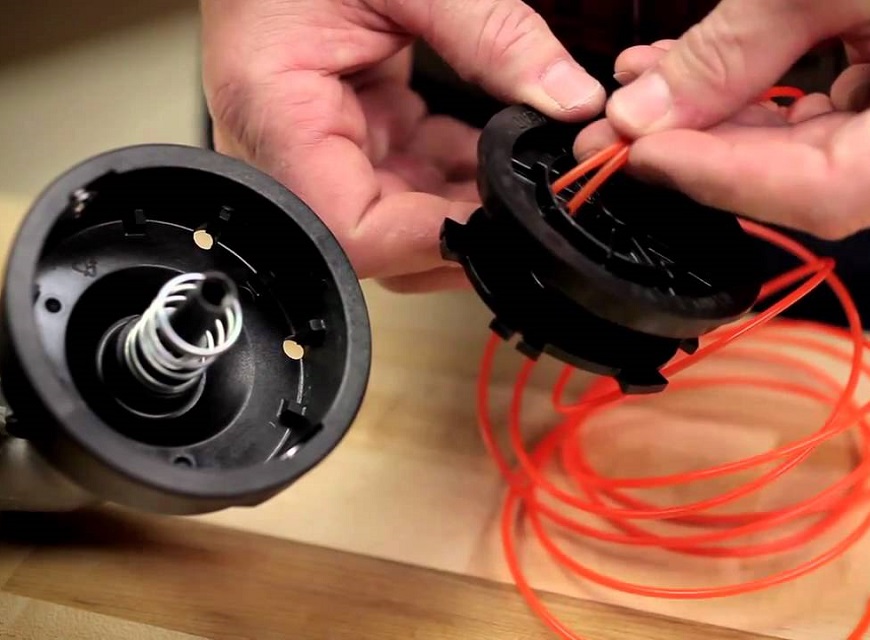
Replacing the strings should also be easier than replacing blades. Additionally, it should be cheaper. This is because strings are as well easily accessible from various vendors.
Walk-behind string trimmers also often have offset decks. This makes it easier to reach some tight spaces. As well they are able to cut close to various buildings as well as around obstacles.
In addition to the benefits of each model, there are a couple of things you need to consider before making your selection and consequent purchase. This is because different models will be suited to different users. Of course, given that we are trying to make your work easier most of the things you need to consider are listed below.
You don’t often find string trimmer machines designed with a specific lawn size in mind. Nevertheless, if you are going to use it on a relatively large area, you will want a more powerful engine. This is because it can get the job done much faster and easier.
On the other hand, it’s not the best financial decision to buy top of the line products for a small piece of lawn. A device that costs half as much will still get the job done.
There are walk-behind string trimmer machines that are suited to open grounds. Others are more suited to working around barriers such as trees, statues, ponds, and fences. Last but not least, there are string trimmers more suitable to uneven ground than others, like the SENIX Walk-Behind Weed Trimmer.
As such, you would do well to study the area you are going to work in and select the appropriate equipment for it.
The person to do the trimming should also be a key focus area concerning the purchase. This is often in regards to the controls of the device. As such, controls that are closer to the engine should be no problem for a young, healthy person. They can bend over and adjust them accordingly. On the other hand, if the user is older, bending may present a problem. As such, it would be a better decision to spend the extra money and get a tool with controls closer to the top.
Also, weight matters. The heavier the walk-behind weed trimmer, the harder the user must push when the grass and weeds get tall. For example, the Powerhorse walk-behind string trimmer is the heaviest in the list.
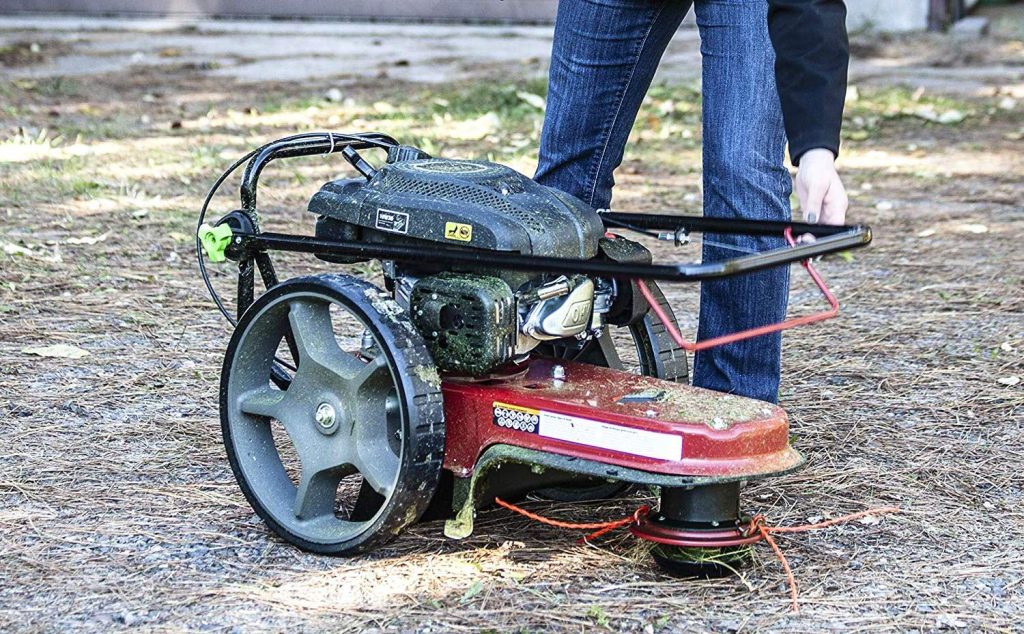
Of course, the device is not going to spend all of its time in your backyard. It will need a shelter away from the elements while it is not in use. This may be in your shed or even garage.
More significant devices will take up more space. The handle may exacerbate this problem as well if it doesn’t fold down.
If you want to purchase any piece of equipment, you need to set aside some money. How much you set aside is dependent on your income as well as recurrent expenditure and constitutes your budget.
Of course, some of the devices you encounter will fit within your budget while some won’t. If you find that the machine you want costs much more than you have, you can change it up for a lower-end model. Alternatively, you can save up more money for the purchase.
The features that make up each device will constitute its overall value. They are also likely to influence how well the tool performs when you put it on your grass. Since features are also part of the decision, we have provided in-depth information on them below.
Of course, the power type is one of the more essential aspects of the device. Gas or cordless electric models are both available nowadays. However, the only electric model that made our list this year is the Earthquake 44965 Electric Walk Behind string Trimmer. Personally, I love an electric model because I don’t like the hassle with gas, noise, and fumes related to a gas model.
If you’re looking at gas options, just by looking at the specs, you can tell if it is powerful enough for the job at hand. For example, the Powerhorse walk-behind string trimmer has the highest cc engine, at a whopping 173cc, but is also the heaviest.
Of course, some of the engines in the market will provide more torque. Others have the advantage of using up less fuel. Also, it is not surprising to find that different types of engines use different types of fuel.
Two of the more common types of engines you find on walk behind string trimmers are the 2-stroke and 4-stroke options.
The 2-stroke engine generally tends to be lighter since it has fewer components. It is also seemingly more efficient in its energy production process.
With regards to the stroke, it can be defined as movement from the top dead center of the cylinder to the bottom dead center. It could also be the movement from the bottom dead center back to the top dead center. As such movement up and down should be considered as two strokes.
In a two-stroke engine, that is enough to complete the power production cycle. If you know the cycle, then you know the steps involved. They include intake where fuel and air come into the cylinder. The next step is the compression of the gases and fuel, which is then followed by combustion.
A spark plug is necessary for the combustion process to start; hence is included in the cylinder. Lastly, you get the exhaust stage where the smoke from the combusted fuel and gas is let out of the cylinder.
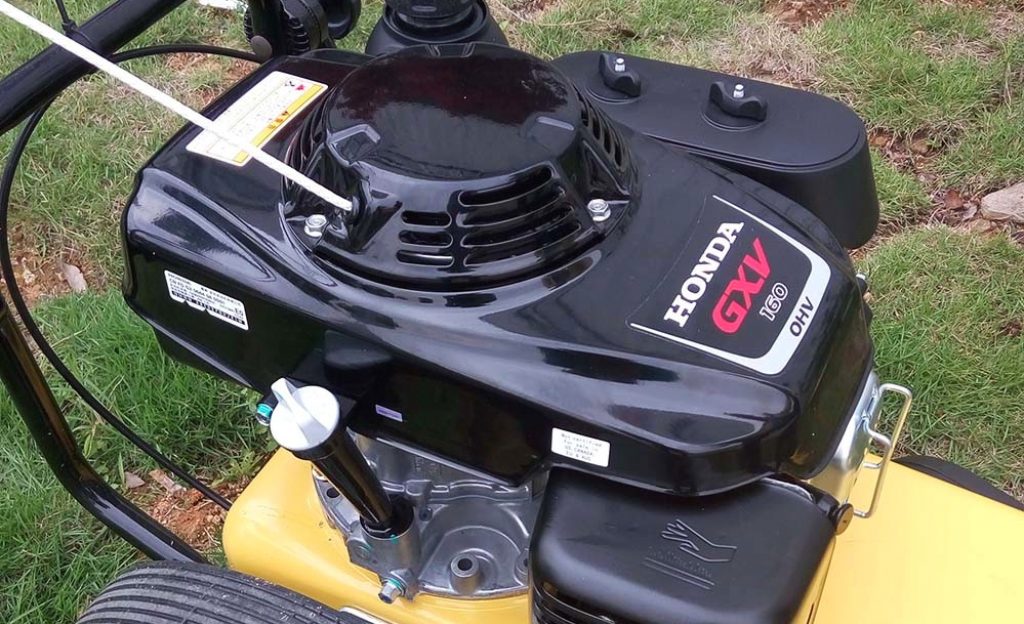
As mentioned before, a 2-stroke engine can pull off all these steps in a single up and down motion hence the name. On the other hand, the 4-stroke engine needs two cycles of the same to pull off the same power production cycle. You will have to pick out one of these two based on the power they produce as well as how they affect the design of the machine.
Another thing that matters is the type of fuel that the device uses. Oil and gas are the two main options to pick from. Of course, each option has advantages of its own, and it may come down to personal preferences.
What we advise is that you go for the gas option if it is available. It constitutes cleaner energy production without giving up much power.
Most of these trimmer devices come with an electric or manual start mechanism or, as it is more aptly named the recoil start. They are inexpensive but will require you expend some of your energy to start the machine. They are also more reliable.
As shown in the list above, all walk-behind string trimmers in the list have a common cutting width of 22”. Also, most devices come with a variable cutting height. You can thus move the trimmer up or down depending on your cutting needs at the time. A prime example of this is the Earthquake 44965 Electric Walk Behind string Trimmer that can cut from 1.5” up to 4.0”, which can be adjusted without using tools.
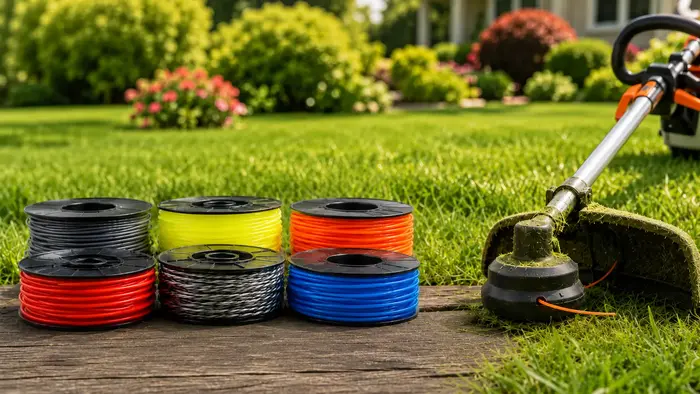
The thicker the line, the more durable it is. As such thick lines can handle dense and thick plants with relative ease. They will also take longer to wear out. Nevertheless, most of these walk behind string trimmers will dictate the diameter of the string you can use.
If you check on the list provided, you will see that almost all the devices mentioned will allow for a 0.155” line diameter.
Bigger is not always better, but in the case of walk-behind string trimmers, go for the machine with the most prominent wheels you can get. 12” is the baseline as it will still allow you to glide over different terrain with relative ease.
Not many people consider the handlebars of these devices as deal breakers in whether they buy the devices or not. Nevertheless, some of them provide extra benefits and are easier to work with.
An example of such is in whether the handlebar has any foam or comfort material. If it is included, it will be more comfortable to hold and use the machine for extended periods. Conversely, you can purchase a pair of comfortable gloves if it doesn’t.
Also, how close are the controls to the handlebar? This will tell you how easy it is to change the torque without letting go of the bar.
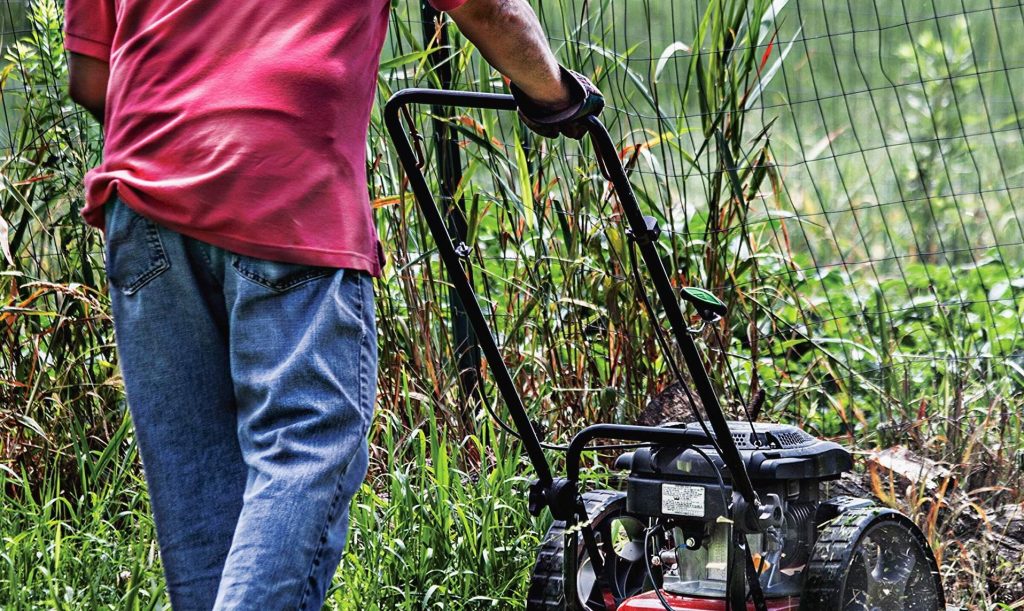
Lightweight devices are more comfortable to lift and carry around if you ever need to transport them to a different location. Also, they tend to be smaller in stature.
You may also appreciate the fact that they take up less storage space. However, this may not be ideal as the small size may eat into the functionality of the invention.
If you are looking to own one of these tools for the long term, an extended warranty is probably a good idea. The five-year warranty provided by the Earthquake models, for instance, is ideal. However, you should know most manufacturers will offer less than that. Also, keep in mind that on batteries of electric models, the warranty is often shorter.
You may still be left with more than one item in your shortlist after considering all the features above. You can break the tie by bringing in any extra features that the devices may have. Examples of such include the Never-Go-Flat wheels of the Earthquake 40314 Walk Behind String Mower, which are very handy on rugged terrain with lots of sharp rocks.



Nice comprehensive blog, thank you